36 To the Children of War
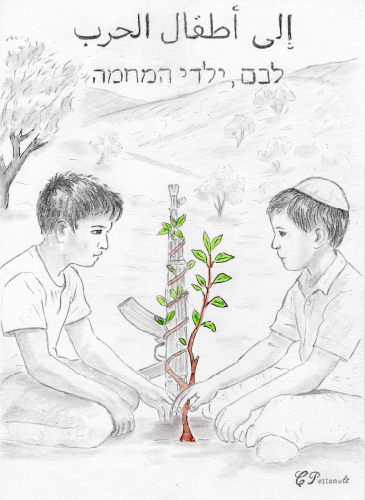
إلى أطفال الحرب / לכם, ילדי המלחמה
Gaza |
Palestine
Arabic, Hebrew
Behind the scenes
This text was born from a reflection on the fate and psychology of children growing up in the midst of war, particularly in the Israeli-Palestinian context. Too often, they are forced to abandon the innocence that should accompany their early years.
I imagined this text as a song-prayer addressed to them, beyond borders and sides. The intention is not to deny the suffering or wounds of each people, but to express a fragile hope: that their hearts may be filled with love rather than resentment.
The illustration, which features the title of the text in both Arabic and Hebrew, shows two children planting a weapon into the ground so that it becomes a tree. An image that may seem naïve. But children know that nothing is impossible.
This is also why the text is presented in both Arabic and Hebrew, like two voices carrying the same call for peace.
Echoes of the world
Arabic and Hebrew are, in fact, closely related languages: they both belong to the Semitic language family and share many common roots. They also have the distinctive feature of being written from right to left.
A striking example is the word for peace. In Arabic, it is سلام (salām), and in Hebrew שלום (shalom). Both words come from the same consonantal root S-L-M, which conveys ideas of peace, harmony, and wholeness. Their kinship is such that their similar sound is immediately recognizable.
This connection also appears in traditional greetings:
السلام عليكم (as-salāmu ʿalaykum) in Arabic and שלום עליכם (shalom aleichem) in Hebrew.
What if we chose to see first what unites us, rather than what divides us?
To reflect and capture your thoughts, turn to the dedicated pages in the book.
Aucune Vidéo disponible
Read and see the stories
Find the stories and all the illustrations of Christophe Perreault in the book.

Download
a free sample
Send the download link to: