02 The Magic of Languages
La magie des langues
Brussels |
Belgium
French
Behind the scenes
I wanted to dedicate this text to the magic of languages, privileged witnesses of human history and its migrations, conquests, and encounters. French itself is the result of multiple layers-Gaulish, Celtic, Latin, and Germanic-and belongs neither solely to France nor even to the Francophone world.
In Brussels, a crossroads city, this becomes immediately clear: languages circulate, blend, and shape the way we think.
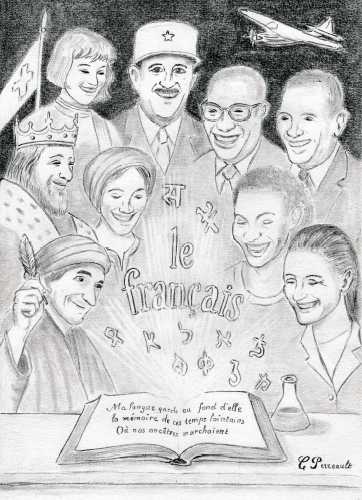
While creating the illustration, I imagined Charlemagne structuring a European space and reforming writing; Erasmus, a humanist figure deeply connected to Brussels, reflecting on the circulation of knowledge and languages across the continent; Joan of Arc embodying political unity at a time when French was asserting itself over Latin; Margaret of Austria turning Brussels into a cultural centre. Then Charles de Gaulle defending French on the international stage, Antoine de Saint-Exupéry carrying it to the world through writing, Léopold Sédar Senghor envisioning Francophonie as a “civilisation of the universal,” Marie Curie anchoring it in science, and Marie-Josée Pérec making it resonate in sport.
Nine faces for a language in constant motion.
Echoes of the world
French is not an isolated language: it lives within the Francophone world, connecting places such as Quebec, Switzerland, Belgium, France, and many African countries. Kinshasa, in the Democratic Republic of the Congo, is now the largest French-speaking city in the world. And it was in Brussels, an international crossroads, that the inspiration for this text came to me.
I wanted to celebrate the beauty of a language with multiple origins: the text includes Latin words such as liberté (“freedom”), words likely of Germanic origin such as blessure (“wound”), Greek echoes such as grammaire (“grammar”), and a few almost hidden Gaulish remnants such as brasser (“to brew”).
I also evoke a fascinating linguistic mystery: Basque, which intriguingly does not belong to the Indo-European language family.
Languages allow us to communicate, to transmit, and to think. They shape each people’s view of the world. When a language disappears, a part of humanity’s heritage fades away.
And you, how do you think your language shapes the way you think?
To reflect and capture your thoughts, turn to the dedicated pages in the book.
Read and see the stories
Find the stories and all the illustrations of Christophe Perreault in the book.

Download
a free sample
Send the download link to: